L073-SUECIA PREMIO NOBEL MEDICINA
American Karl Deisseroth and Germans Peter Hegemann and Georg Nagel won the 2026 Nobel Prize in Physiology or Medicine on Monday (October 5) for their discoveries on light and optogenetics that have helped understand how the brain works.
The Nobel Assembly of Sweden's Karolinska Institute medical university said Deisseroth, 54, Hegemann, 71, and Nagel, 73, were selected for their "discoveries concerning light-gated ion channels and optogenetics."
Optogenetics "makes it possible to switch on, or off, the activity of individual nerve cells in a living brain," said Thomas Perlmann, Secretary-General of the Nobel Assembly at Karolinska Institutet.
In clinical trials, researchers are restoring vision to people blinded by a condition called retinitis pigmentosa by inserting a light-sensitive protein in the retina.
Researchers also hope optogenetics could improve cochlea implants, allowing more precise stimulation of the auditory nerve than current electrical devices.
The physiology or medicine prize traditionally opens the annual Nobel announcements, with awards in physics, chemistry, literature, peace and economics to follow over the coming days.
Deisseroth, Hegemann and Nagel will share a prize sum amounting to 12 million Swedish crowns ($1.2 million).
DESCRIPCIÓN DE IMÁGENES
STOCKHOLM, SWEDEN (OCTOBER 5, 2026)(REUTERS - Access all)
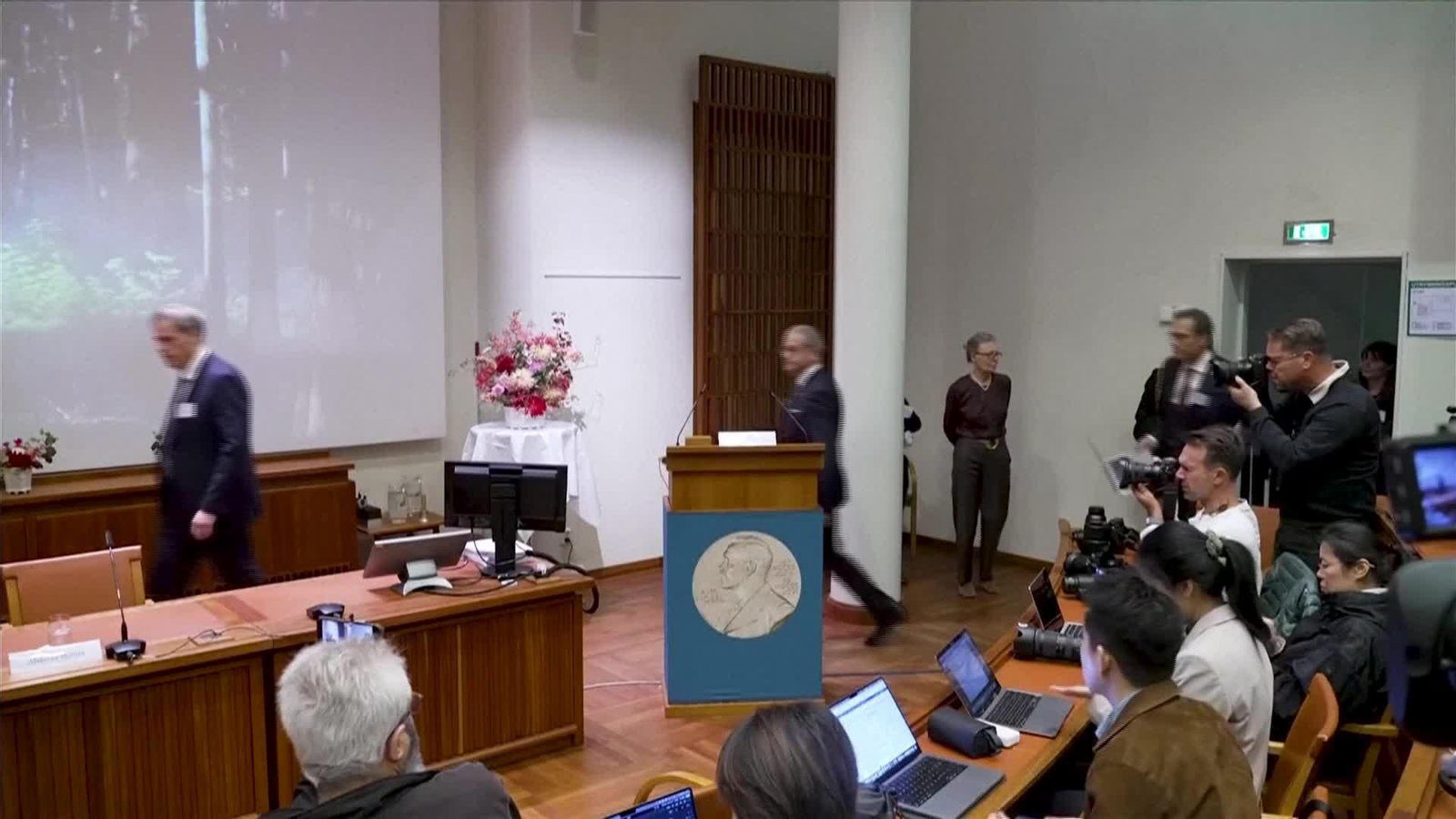
1. MEMBERS OF NOBEL COMMITTEE ARRIVING FOR ANNOUNCEMENT
2. SECRETARY OF THE KAROLINSKA INSTITUTE NOBEL COMMITTEE, THOMAS PERLMANN, AT LECTERN
3. (SOUNDBITE)(English) SECRETARY-GENERAL OF THE NOBEL COMMITTEE AT THE KAROLINSKA INSTITUTE, THOMAS PERLMANN, SAYING:
“The Nobel Assembly at Karolinska Institutet has today decided to award the 2026 Nobel Prize in Physiology or Medicine jointly to Karl Deisseroth, Peter Hegemann and Georg Nagel for their discoveries concerning light-gated ion channels and optogenetics.”
4. SCREEN SHOWING PHOTOGRAPHS OF LAUREATES
5. JOURNALISTS SEATED
6. MEMBER OF THE NOBEL COMMITTEE AND PROFESSOR OF NEUROSCIENCE AT KAROLINSKA, ABDEL EL MANIRA GIVING A PRESENTATION ABOUT THE SCIENCE BEHIND THE PRIZE
7. VARIOUS OF PRESE NTATION
8. (SOUNDBITE)(English) ABDEL EL MANIRA, SAYING:
“The impact of optogenetics extends far beyond understanding the healthy brain. It has also helped reveal how specific brain circuits are disrupted, with implications for conditions such as blindness, depression, addiction and dementia.”
9. WIDE OF PRESENTATION
10. PEOPLE LISTENING
11. PERLMANN AT PRESS CONFERENCE
12. (SOUNDBITE)(English) SECRETARY OF THE KAROLINSKA INSTITUTE NOBEL COMMITTEE, THOMAS PERLMANN, SAYING:
“I should say that all three the were very surprised. All three said the same thing, that they thought it was absolutely wonderful to receive the prize with the other two and they call them ‘my friends’. That it's such an honour to receive them together. So that's something they conveyed,.”
13. PERLMANN AT PRESS CONFERENCE/ SCREEN WITH PHOTOS OF LAUREATES
14. NOBEL EMBLEM ON LECTERN
15. PROFESSOR IN GENETICS AND MEMBER OF THE NOBEL COMMITTEE FOR PHYSIOLOGY OR MEDICINE, ANNA WEDELL, SAYING:, BEING INTERVIEWED
16. (SOUNDBITE)(English) PROFESSOR IN GENETICS AND MEMBER OF THE NOBEL COMMITTEE FOR PHYSIOLOGY OR MEDICINE, ANNA WEDELL, SAYING:
“It's for a light-sensitive switch for nerve cells. So we have a new tool to actually switch on and off nerve cells in a living brain. So we can understand the function of the brain in a very new way. (JOURNALIST ASKING: And why is that important?) Because we have so much to learn about our brain. It's such a complex organ and we know very little. We need more knowledge, both for basic science but also to understand eventually the different disorders that affect the brain in humans.”
17. VARIOUS OF WEDELL BEING INTERVIEWED
18. (SOUNDBITE)(English) PROFESSOR IN GENETICS AND MEMBER OF THE NOBEL COMMITTEE FOR PHYSIOLOGY OR MEDICINE, ANNA WEDELL, SAYING:
“This has actually opened a whole new era in neuroscience. We're still in the beginning, so for the first time we can start to understand how the brain processes information and how different neurons interact across the brain, not just have an anatomical map of the brain, but also how the networks are connected. And start to ask questions, which networks are active when we do different types of behaviours, experience emotions and even store memories. So it's still very early in a very new era, so we will learn a lot from this.”
19. NOBEL EMBLEM ON LECTERN
20. (SOUNDBITE)(English) PROFESSOR IN GENETICS AND MEMBER OF THE NOBEL COMMITTEE FOR PHYSIOLOGY OR MEDICINE, ANNA WEDELL, SAYING:
“Well, the most important collaboration was that the scientists who found the protein, Peter Hagemann and Georg Nagel, they actually gave it to Karl Deisseroth so he could do his experiments in nerve cells. So that was a very important collaboration. But then since then, this was one protein. Now this has been, there are many different similar proteins that react to different wavelengths of light and they can turn on and can turn off. So there's a lot of technological developments going on to really sharpen this tool and further develop this tool.”
21. VARIOUS OF BUST OF ALFRED NOBEL
22. VARIOUS EXTERIORS OF NOBEL FORUM WHERE ANNOUNCEMENT IS MADE