D006-BOLIVIA NUEVA ESPECIE DE FELINO
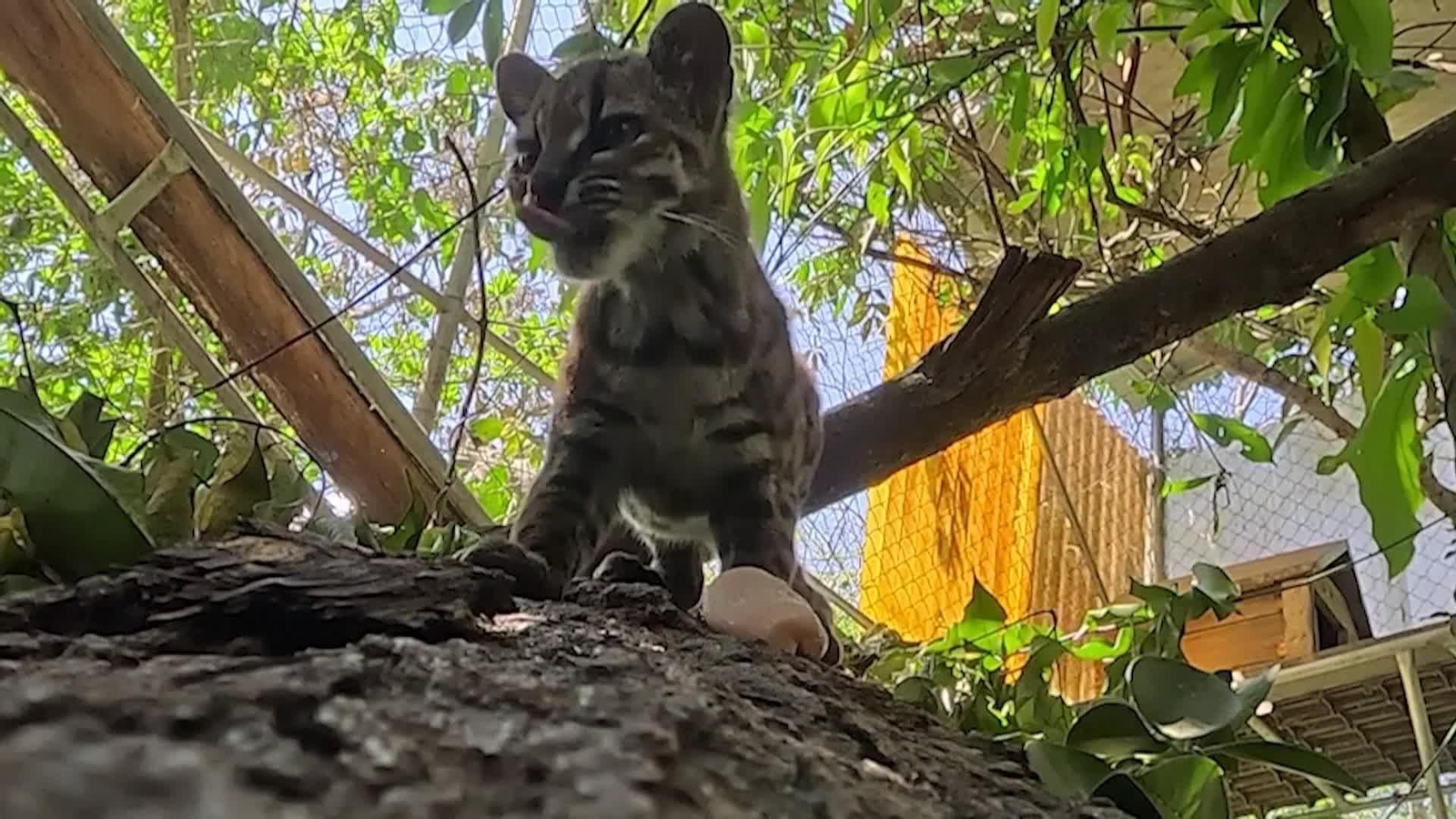
Tigrino, a 10-year-old wildcat at Bolivia's Senda Verde Wildlife Sanctuary, is one of only two known living representatives of the newly identified Leopardus tilcayo species. He is the only one under permanent human care.
The cat is part of a group called tiger cats found across much of South America. It was found in Bolivia's lush Yungas forest, a mountainous region where forests are often covered by clouds and surrounded by high humidity, according to researchers. It measures about 18 inches (46 cm) long and weighs around 3 pounds (1.4 kg), making it smaller than the average domestic cat.
Rescued in 2017, he was kept by a local family in their home before arriving at the sanctuary, and has become the face of one of the most significant scientific discoveries in recent years.
Researchers used genetic data to confirm that the cat is a new species, and gave it the scientific name Leopardus tilcayo, retaining its local name.
Biologist and National Geographic Explorer Paola Nogales-Ascarrunz told Reuters on Saturday (September 19) researchers decided to retain the name to honor indigenous knowledge. "We have decided to keep this name, which is Leopardus Tilcayo, for its scientific name and for the common name of the species."
Nogales-Ascarrunz is one of the authors of the study describing the newly identified species published on Thursday (September 17) in the journal Current Biology.
While Tilcayos still exist in Bolivia's wild Yungas forest, Tigrino cannot be returned. After nearly a decade in captivity and lacking proper nutrition during his youth, reintroduction would be impossible, Nogales-Ascarrunz explained.
At Senda Verde, Tigrino shares space with more than 1,200 other rescued animals. Sanctuary co-founder Marcelo Levy said the refuge's mission is to "save and shelter wild animals rescued from illegal trafficking, from the destruction of their habitat."
The threats are immediate. A mining cooperative operates just meters from the sanctuary, Levy told Reuters, "affecting the animals through noise, pollution and the movement of machinery." The encroachment has introduced severe physical disruptions to the wildlife.
With habitats fracturing, Nogales-Ascarrunz emphasized the urgency of protecting the forest where Tigrino's wild cousins still roam. "Let us hope that this brings more attention to the conservation of the Yungas forest," she said. "If there is no habitat, there is no cat either."
DESCRIPCIÓN DE IMÁGENES
TIGRINO THE ONLY INDIVIDUAL OF LEOPARDUS TILCAYO THAT CAN BE VISITED AT SENDA VERDE WILDLIFE SANCTUARY IN BOLIVIA / OTHER ANIMALS IN REFUGE / SOUNDBITES FROM SENDA VERDE WILDLIFE SANCTUARY CO-FOUNDER AND BIOLOGIST AND NATIONAL GEOGRAPHIC EXPLORER
RESENDING WITH COMPLETE SCRIPT
SHOWS: COROICO, LA PAZ, BOLIVIA (SEPTEMBER 19, 2026) (REUTERS - Access all)
1. VARIOUS OF TIGRINO, THE ONLY INDIVIDUAL OF LEOPARDUS TILCAYO THAT CAN BE VISITED
2. VARIOUS OF TIGRINO, THE ONLY INDIVIDUAL OF LEOPARDUS TILCAYO, EATING IN ENCLOSURE
3. (SOUNDBITE) (Spanish) BIOLOGIST AND NATIONAL GEOGRAPHIC EXPLORER, PAOLA NOGALES-ASCARRUNZ, SAYING:
"Honouring this local knowledge and also to be able to keep all these stories that exist about the cat, since surely people have anecdotes, have stories, perhaps legends, it is something new to explore, we have decided to keep this name, which is Leopardus Tilcayo, for its scientific name and for the common name of the species, Tilcayo."
4. (MUTE) VARIOUS DRONE SHOTS OF SENDA VERDE WILDLIFE SANCTUARY
5. VARIOUS OF TIGRINO, THE ONLY INDIVIDUAL OF LEOPARDUS TILCAYO, IN ENCLOSURE
6. (SOUNDBITE) (Spanish) BIOLOGIST AND NATIONAL GEOGRAPHIC EXPLORER, PAOLA NOGALES-ASCARRUNZ, SAYING:
"Tilcayo, as such, is in the Yungas forest, in the wild. It is not that the cat at Senda Verde is the only one. What is true is that it is the only one under human care, because this cat is already quite old. So it cannot be reinserted back. Also, it has been under human care for a long time in this house, so it did not receive the necessary supplements when it was young. It is complicated to reinsert an animal like that back into nature."
7. VARIOUS OF JAGUARS IN SENDA VERDE WILDLIFE SANCTUARY
8. (SOUNDBITE) (Spanish) SENDA VERDE WILDLIFE REFUGE CO-FOUNDER, MARCELO LEVY, SAYING:
"Today, Senda Verde is the home of more than 1,200 animals and its vision of why we exist is to save and shelter wild animals, rescued from illegal trafficking, from the destruction of their habitat, from pain and suffering, but at the same time we are also here to inspire."
9. VARIOUS OF JAGUARS IN SENDA VERDE WILDLIFE SANCTUARY
10. (SOUNDBITE) (Spanish) SENDA VERDE WILDLIFE SANCTUARY CO-FOUNDER, MARCELO LEVY, SAYING:
"So if there is a mining cooperative working very close to Senda Verde or a few metres away, they are affecting the animals through noise, through pollution, through the movement of machinery, and therefore also the human neighbours."
11. VARIOUS OF MARCELO LEVY, OF SENDA VERDE WILDLIFE SANCTUARY, HOLDING SMALL MONKEY AND INTERACTING WITH OTHER MONKEYS
13. (SOUNDBITE) (Spanish) BIOLOGIST AND NATIONAL GEOGRAPHIC EXPLORER, PAOLA NOGALES-ASCARRUNZ, SAYING:
"Let us hope that this calls more for the conservation of the Yungas forest, which is now threatened, precisely, by deforestation, by mining and all this, so we hope that we do not only use the cat as a banner, which is a new 'michi' (the way Bolivians refer to cats) for Bolivia, that we are all proud of, but that we take action to rescue, to restore the Yungas forest and conserve the cat's habitat, because if there is no habitat, there is no cat either."
14. VARIOUS OF TIGRINO
15. VARIOUS OF DIFFERENT MONKEYS WITH CAREGIVER AND INSIDE ENCLOSURES IN SENDA VERDE SANCTUARY